Historic Native Peoples of Texas by William C. Foster
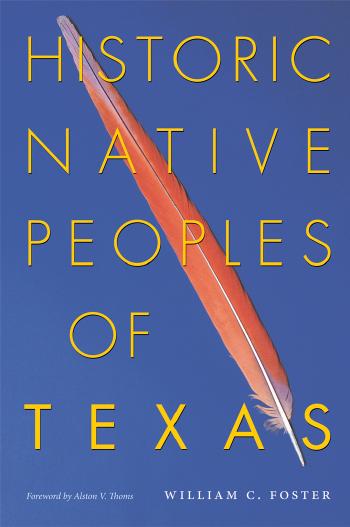
Author:William C. Foster
Language: eng
Format: epub, pdf
Publisher: University of Texas Press
Published: 2008-11-14T16:00:00+00:00
1600s
About two and one-half years after Vicenteâs expedition westward toward Area VI, Oñate himself led an expedition across Area VI to Quivira along the same general route that Coronado had taken about sixty years earlier.32 Unlike Coronadoâs expedition party, Oñateâs troops were supported by six mule and ox carts carrying cannon. Vicente de ZaldÃvar, Jusepe, and two Franciscan friars accompanied seventy soldiers. Governor Oñate reached the Pecos River in five days from the Rio Grande; with an additional three-day march the party reached the Canadian River. Here a group of Indians that the chroniclers called Apache welcomed the Spaniards in a peaceful manner. From the location of the Apache, it appears that the Natives may have been related to Southern Plains people who earlier had been called either the Querecho or the Vaquero by Spanish diarists.
For the next 300 miles of the journey, Oñateâs troops followed the flow and direction of the Canadian River commenting frequently on the lifeways of the numerous Apache bands encountered and on the flora and wild animals found in the northern part of Area VI. Apaches were described as the masters of the Plains, people who had no permanent settlements and cultivated no crops, just as reported during Vicenteâs 1598 journey to the Plains. The Teyas, who proved so helpful to Coronado in the same area, were not mentioned.
Oñate located the first bison soon after entering the Texas Panhandle in Area VI, and thereafter the party was never far from large herds. Oñateâs chroniclers write that often bison would not even run as the Spaniards approached and that the animals were far too numerous to count. In addition to bison, the Spanish scouts also saw large herds of 200 to 300 antelope which âin their deformed shapeâ made the soldiers uncertain if they were a special species of deer or some other animal. They also reported seeing deer, jackrabbits, wild turkey, and quail.
Soon after entering Area VI, the chroniclers reported finding plums and other unrecognized wild fruit. The Apachesâ first gifts to the Spanish troops included small black and yellow fruit the size of small tomatoes, which might have been wild plums or persimmons or both. The soldiers found a variety of plums that grew on small trees and picked sweet and tasty grapes on vines all along the route through Area VI. In the wooded ravines spring water was also often found, as was reported on Coronadoâs earlier expedition through the area.
After marching eastward along the Canadian River for about 200 miles, Oñate turned northeast and then moved more northward toward Quivira. Before reaching Quivira and the Wichita Indians on the Arkansas River in central Kansas, Oñate encountered a second tribe who, like the Apache, were nomadic and followed the bison herds. Oñate decided to call the Indians the Escanjaque because it sounded like a word that the tribal members often repeated.33 These Plains Indians were at war with the sedentary Wichita farmers, who had numerous permanent villages located as close as twenty-five miles northeast of where the Escanjaque were found.
Download
Historic Native Peoples of Texas by William C. Foster.pdf
This site does not store any files on its server. We only index and link to content provided by other sites. Please contact the content providers to delete copyright contents if any and email us, we'll remove relevant links or contents immediately.
| Africa | Americas |
| Arctic & Antarctica | Asia |
| Australia & Oceania | Europe |
| Middle East | Russia |
| United States | World |
| Ancient Civilizations | Military |
| Historical Study & Educational Resources |
The Dawn of Everything by David Graeber & David Wengrow(1763)
The Bomber Mafia by Malcolm Gladwell(1667)
Facing the Mountain by Daniel James Brown(1598)
Submerged Prehistory by Benjamin Jonathan; & Clive Bonsall & Catriona Pickard & Anders Fischer(1494)
Tip Top by Bill James(1490)
Wandering in Strange Lands by Morgan Jerkins(1482)
Driving While Brown: Sheriff Joe Arpaio Versus the Latino Resistance by Terry Greene Sterling & Jude Joffe-Block(1410)
Red Roulette : An Insider's Story of Wealth, Power, Corruption, and Vengeance in Today's China (9781982156176) by Shum Desmond(1395)
Evil Geniuses: The Unmaking of America: A Recent History by Kurt Andersen(1393)
The Way of Fire and Ice: The Living Tradition of Norse Paganism by Ryan Smith(1369)
American Kompromat by Craig Unger(1361)
F*cking History by The Captain(1350)
It Was All a Lie by Stuart Stevens;(1341)
American Dreams by Unknown(1319)
Treasure Islands: Tax Havens and the Men who Stole the World by Nicholas Shaxson(1304)
Evil Geniuses by Kurt Andersen(1297)
White House Inc. by Dan Alexander(1243)
The First Conspiracy by Brad Meltzer & Josh Mensch(1216)
The Fifteen Biggest Lies about the Economy: And Everything Else the Right Doesn't Want You to Know about Taxes, Jobs, and Corporate America by Joshua Holland(1159)
